A family car is only as practical as its boot. This guide compares boot space across India’s most popular family cars—from the Kia Carens to the Honda City—and explains why the largest boot is not always the best choice once passengers are on board.
Introduction
Choosing family cars with boot space in India is harder than it looks. Brochure figures measure the boot with all seats in place, but a seven-seater with six people aboard has almost no luggage room left. A five-seater sedan with a 500-litre boot may actually be more practical for a family of four on a highway trip than a three-row MPV with 200 litres behind the third row.
This guide compares boot space across India’s most relevant family cars, explains the seating-versus-luggage trade-off, and flags where the available data is unreliable. It does not pretend that one car fits every family. Instead, it helps you match boot capacity to how you actually travel.
Data reliability warning: Indian-market boot space figures are inconsistently reported. Some manufacturer websites do not publish boot volume at all. Where this article uses figures from non-Indian market specifications or older model years, those are clearly flagged. Verify current India-spec figures with your dealer before deciding.
Table of Contents
- The Boot Space Problem in Family Car Buying
- Verified Boot Space Comparison
- Kia Carens: The Practical Seven-Seater
- Maruti Suzuki Ertiga: Budget MPV Champion
- Toyota Innova Hycross: Comfort Over Cargo
- Honda City: The Sedan Alternative
- Hyundai Creta: SUV Compromise
- Which Family Car Should You Buy?
- Common Mistakes to Avoid
- FAQs
- Final Verdict
1. The Boot Space Problem in Family Car Buying
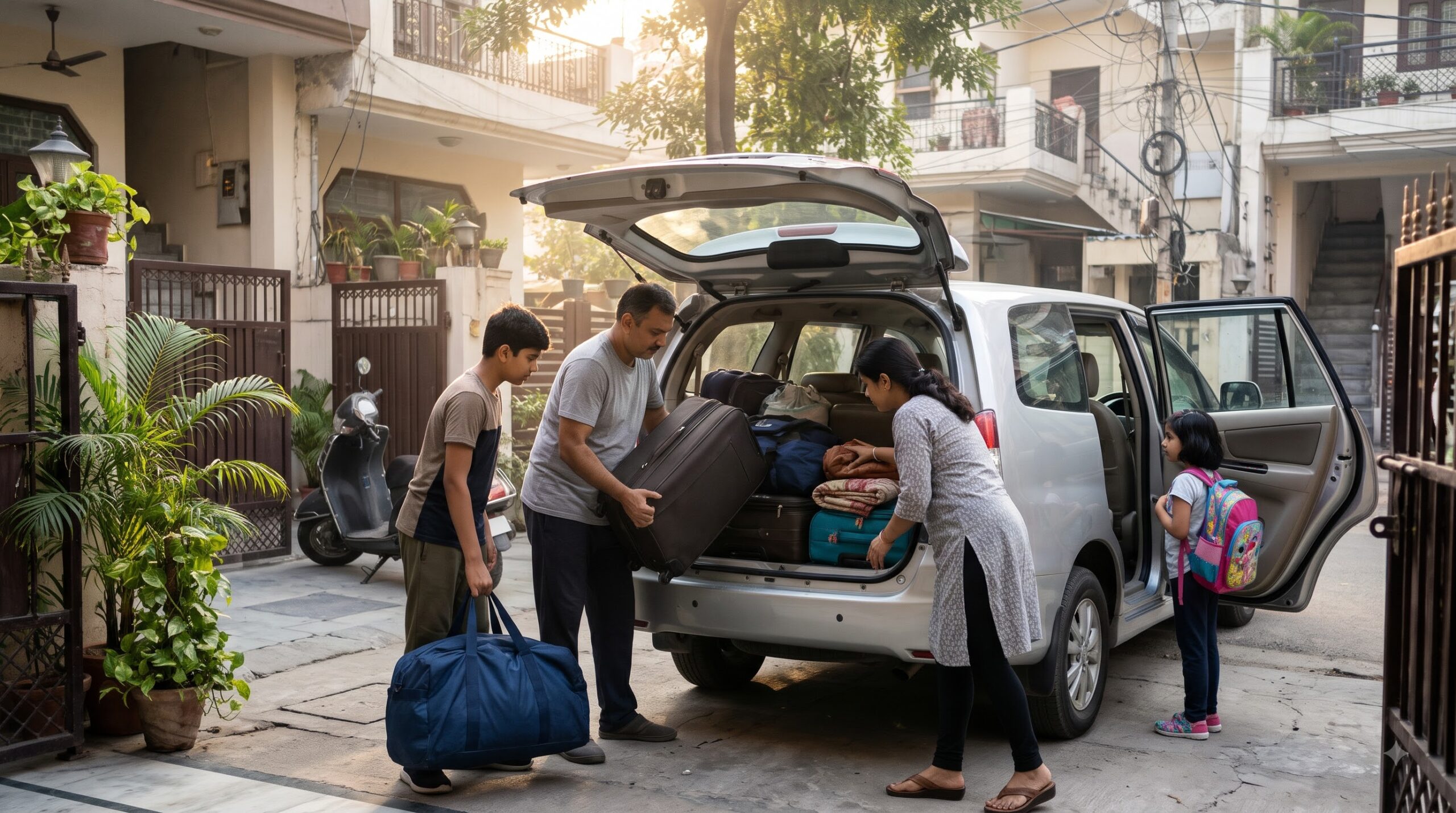
Most Indian families buy a car based on seating capacity and price, then discover the boot is inadequate for the annual Diwali trip to the hometown. The reason is simple: a seven-seater carrying seven people has almost no usable boot. The third row, when occupied, consumes the space that would otherwise hold luggage.
Autocar India’s buying advice addresses this directly. For a reader seeking captain seats and ample boot space under ₹30 lakh for weekend highway trips with a young child, the recommendation was the Kia Carens, specifically because “with the third row folded, it provides a large luggage bay” . The implication is clear: the Carens works best as a four- or five-seater with a huge boot, or a six-seater with modest luggage.
The practical question is not “which car has the biggest boot?” It is “which car has the biggest boot in the seating configuration I will actually use?”
2. Verified Boot Space Comparison
The table below consolidates boot space figures from available sources. Read the notes column carefully. Several figures are not for the India-spec current model.
Critical notes:
- The Kia Carens figures (216L/645L) come from Kia’s own website for Mauritius and Indonesia . MotorOctane uses identical figures for its India comparison , suggesting they may be standardised across markets. However, confirm with Kia India.
- The Ertiga figure of 209L comes from MotorOctane, not Maruti Suzuki . A separate CarTrade result gives 135 litres for the 2015 Ertiga , which is irrelevant to the current model but illustrates how outdated data persists online.
- The Innova Hycross figure of 239L is from RushLane . Autocar India’s comparison does not state a boot figure for the Hycross . This is the least certain figure in the table.
3. Kia Carens: The Practical Seven-Seater
Boot space: 216 litres (all rows up) / 645 litres (third row folded)
Source confidence: Moderate. Kia official figures for non-Indian markets; MotorOctane uses same numbers .
The Carens is Autocar India’s recommendation for a family prioritising captain seats and luggage space under ₹30 lakh . Its strength is flexibility: fold the third row and you have a genuinely large luggage bay that rivals some SUVs. Keep all three rows up and you have a usable seven-seater with enough boot for a few soft bags.
The trade-off: With seven people on board, 216 litres is tight for a family holiday. Autocar’s recommendation implicitly assumes the third row will often be folded, turning the Carens into a spacious five-seater with a large boot.
Who it suits: Families of four or five who occasionally need a third row, and who prioritise luggage capacity over permanent seven-seat usability. The captain-seat variants (if available within budget) add comfort for second-row passengers.
4. Maruti Suzuki Ertiga: Budget MPV Champion
Boot space: 209 litres (all rows up) / 550 litres (third row folded)
Source confidence: Moderate. MotorOctane figure . Not verified against Maruti Suzuki India official specification.
The Ertiga has been India’s default budget MPV for years, and the current generation continues that role. ZigWheels lists it at ₹8.90–13.14 lakh (Delhi ex-showroom), making it significantly cheaper than the Carens .
Its boot space with all rows up (209 litres) is slightly smaller than the Carens (216 litres), and the folded capacity (550 litres) is also smaller. However, the Ertiga’s lower price means buyers can accept a slightly smaller boot or spend the savings on roof carriers or a tow-hitch luggage box.
The trade-off: The Ertiga’s third row is best for children or short trips. With all three rows occupied, luggage space is minimal. The CNG variant further reduces boot space due to the tank. [VERIFY CNG boot space with dealer.]
Who it suits: Budget-conscious families who need occasional seven-seat capability and are willing to travel light when all seats are filled.
5. Toyota Innova Hycross: Comfort Over Cargo
Boot space: 239 litres (all rows up, per RushLane)
Source confidence: Low. Single source; not cross-verified .
The Innova Hycross is India’s benchmark for comfortable family transport, but its boot space with all three rows in use is modest. Autocar India’s comparison notes the Hycross is “the most comfortable and refined option overall” for the reader seeking captain seats and space, but “the captain seat variants typically stretch beyond your budget once on-road costs are considered” under ₹30 lakh .
The trade-off: The Hycross prioritises passenger comfort over luggage capacity. If you regularly carry six or seven people with luggage, the boot will be a constraint. If you mostly use it as a five- or six-seater with the third row folded, the flexibility improves.
Who it suits: Families who value ride comfort, refinement, and hybrid efficiency over maximum luggage capacity. Buyers who can stretch beyond ₹30 lakh for captain-seat variants.
6. Honda City: The Sedan Alternative
Boot space: 506 litres
Source confidence: High for the figure itself; CarTrade lists it consistently across variants . India-spec verification recommended but plausible.
The Honda City demonstrates that body style matters more than seat count for boot space. A sedan with a 506-litre boot can swallow more luggage than any three-row MPV with all seats occupied. For a family of four or five, the City may be more practical than a seven-seater for highway trips.
The trade-off: You lose the third row entirely. The City is a five-seater, not a seven-seater. Its boot is deep and usable, but the load aperture is smaller than an SUV’s or MPV’s, making bulky items harder to load.
Who it suits: Families of four or five who prioritise luggage capacity and fuel efficiency over passenger count. If you do not need seven seats, the City’s boot is a genuinely strong argument.
7. Hyundai Creta: SUV Compromise
Boot space: 416 litres (UAE spec) or approximately 433 litres (implied by Autocar comparison)
Source confidence: Low for India-spec. Conflicting figures .
The Creta is India’s most popular SUV, but its boot space is a compromise. The available figures are inconsistent: Hyundai UAE lists 416 litres , while Autocar India’s comparison with the Bayon implies the Creta has around 433 litres (since the Bayon’s 505 litres is “72 litres more”) . Neither figure is confirmed for the India-spec model.
The trade-off: The Creta offers five seats and a boot that is larger than a three-row MPV with all seats up, but smaller than a Honda City sedan. It is a reasonable compromise for families of four, but not a luggage champion.
Who it suits: Buyers who want SUV ground clearance and road presence, accept a mid-sized boot, and do not need seven seats.
8. Which Family Car Should You Buy?
A practical warning: Do not choose a car solely on the all-seats-up boot figure. Think about your most common configuration. If you rarely carry seven people, the folded-third-row capacity matters more. If you regularly carry seven, accept that luggage will be limited and plan accordingly (roof box, trailer, or travelling light).
9. Common Mistakes to Avoid
Mistake 1: Trusting brochure boot figures without checking the seating configuration. A 216-litre boot sounds adequate until you realise it is measured with all seven seats upright and occupied.
Mistake 2: Assuming a seven-seater is always more practical. For a family of four, a Honda City with a 506-litre boot is more practical than a Carens with seven seats up and 216 litres of luggage space.
Mistake 3: Ignoring boot shape and aperture. A deep sedan boot may hold more usable volume than a taller SUV boot with a high load lip. Check the shape, not just the number.
Mistake 4: Forgetting CNG reduces boot space. CNG variants of the Ertiga and other MPVs sacrifice boot volume for the tank. If you need luggage space, petrol or diesel may be more practical.
Mistake 5: Relying on non-Indian-market figures. South African, UAE, and Indonesian specifications may differ from India-spec cars. Always verify with an Indian dealer or official brochure.
10. FAQs
Which family car has the largest boot space in India?
Among the cars compared here, the Honda City has the largest boot at 506 litres with all seats in place . However, it is a five-seater sedan, not a seven-seater. Among seven-seaters, the Kia Carens has the largest folded-third-row capacity at 645 litres .
What is the boot space of Kia Carens with all seats up?
216 litres according to Kia’s official specifications and MotorOctane’s India comparison . This is enough for a few soft bags but limited for a full family holiday with seven occupants.
Is Maruti Ertiga good for family trips with luggage?
The Ertiga is a budget-friendly seven-seater, but with all three rows occupied, boot space is 209 litres . It works best for families who fold the third row when carrying significant luggage, or who travel light.
Which 7-seater has the best boot space for highway travel?
For highway travel with luggage, the Kia Carens is the strongest option among seven-seaters when the third row is folded (645 litres) . If you need all seven seats and luggage, no MPV in this price range is genuinely generous—consider a roof carrier or a larger vehicle.
Honda City vs Hyundai Creta: which has more boot space?
The Honda City has 506 litres . The Creta’s India-spec figure is unverified but appears to be around 416–433 litres based on available data . The City is the more practical choice for luggage capacity.
11. Final Verdict
The best family car with boot space in India depends entirely on your seating pattern. If you rarely carry more than five people, a Honda City offers more usable luggage room than most seven-seaters with all rows occupied. If you need occasional seven-seat flexibility and prioritise a large boot when the third row is folded, the Kia Carens is the strongest all-rounder, as Autocar India’s buying advice confirms . The Maruti Ertiga delivers similar flexibility at a lower price, accepting a slightly smaller boot. The Innova Hycross prioritises comfort over cargo, and the Creta is a five-seat SUV compromise.
Before you decide, measure your actual luggage: the suitcases, strollers, and cricket kits you typically carry. Then check the boot in person with the seating configuration you will use most. The number on the brochure matters less than whether your family’s bags actually fit.
MOTORFOLIO — The Road to a Better Decision.