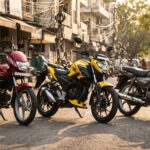

The Honda SP125 and TVS Raider are separated by a few thousand rupees at the showroom, but the real value gap emerges over months of ownership. This comparison resolves conflicting mileage claims, explains why the Raider’s ABS availability matters, and delivers a verdict based on running costs rather than brochure appeal.
Introduction
The Honda SP125 vs TVS Raider comparison looks straightforward on paper. Both are 125cc commuters, both start under ₹1 lakh, both promise fuel efficiency, and both come from manufacturers with strong service networks. The decision should be easy.
It is not. The two bikes embody different philosophies. The SP125 is Honda’s refined, conservative commuter—the Shine with slightly better equipment. The Raider is TVS’s attempt to make the 125cc segment exciting, with a sporty chassis, a TFT screen on top variants, and riding modes. One prioritises low-stress ownership. The other prioritises engagement and features.
This comparison cuts through the spec sheets to answer the only question that matters: which one offers better overall value for an Indian commuter? It uses verified figures, flags where sources disagree, and weighs running costs as heavily as purchase price.
Price note: All prices are ex-showroom, Delhi unless stated otherwise, based on data available as of November 2026. On-road prices vary by city and insurance. Verify with your dealer before booking.
Table of Contents
- Price Comparison: What You Actually Pay
- Engine and Performance: Marginal Differences
- Mileage and Running Costs: The Real Value Gap
- Safety: ABS vs CBS
- Features and Equipment
- Service and Ownership Costs
- Which Bike Should You Buy?
- Common Mistakes to Avoid
- FAQs
- Final Verdict
1. Price Comparison: What You Actually Pay
The two bikes overlap at the bottom and diverge at the top.
| Variant | Honda SP125 | TVS Raider |
|---|---|---|
| Base (drum brake) | ₹90,498 | ₹82,860–84,460 |
| Mid (disc brake) | ₹98,086 | ₹87,600–95,465 |
| Top (TFT/ABS) | Not available | ₹1,03,000 (TFT DD) |
What this reveals: The Raider’s base variant is roughly ₹6,000–7,600 cheaper than the SP125’s base. That is a meaningful gap for a budget commuter. However, the SP125’s top variant (₹98,086) sits below the Raider’s ABS-equipped top variant (₹1.03 lakh). The SP125 has no ABS option at any price.
Autocar India lists the Raider’s on-road Delhi range at ₹92,038 to ₹1.13 lakh, depending on variant . The SP125’s on-road Delhi range is ₹97,195 to ₹1.05 lakh .
The practical takeaway: If you want the lowest entry price, the Raider wins. If you want ABS, you must buy the Raider’s top variants—the SP125 does not offer it.
2. Engine and Performance: Marginal Differences
The Raider makes marginally more power and torque, and its 20mm higher ground clearance is a genuine advantage on Indian roads . However, it is also 7–9 kg heavier, which offsets some of the performance advantage in city traffic.
Drivio’s assessment is blunt: the Raider “pulls harder in the midrange” but the difference is not transformative . Neither bike is fast. Both are adequate for city commuting and strained on highways with a pillion.
Editorial opinion: The performance gap is too small to be a deciding factor. The Raider feels slightly more eager; the SP125 feels slightly smoother. Neither difference justifies the purchase on its own.
3. Mileage and Running Costs: The Real Value Gap
This is where the comparison becomes genuinely interesting—and where the source data is most unreliable.
The Mileage Discrepancy
The TVS Raider’s fuel efficiency is reported inconsistently across sources:
- 71.94 kmpl — cited by HT Auto and BikeDekho comparison pages
- 56.7 kmpl — cited by Autocar India’s FAQ (updated November 2026) and BikeWale’s 2026 TFT DD listing
Which figure is credible? The 56.7 kmpl figure aligns with Autocar India’s editorial authority and the specific 2026 model year listing. The 71.94 kmpl figure appears on aggregator pages that may be recycling older test data or conflating variants. This article uses 56.7 kmpl as the ARAI figure for the Raider, but acknowledges the uncertainty.
The Honda SP125’s figures are more consistent: 63 kmpl ARAI, with user-reported averages of 54 kmpl (ZigWheels) and 61.51 kmpl (Autocar India) .
The Monthly Cost Calculation
Drivio provides a useful real-world framework, assuming ₹103 per litre and 1,000 km per month :
- TVS Raider (assuming 52 kmpl real-world): approximately ₹1,980 per month
- Honda SP125 (assuming 58 kmpl real-world): approximately ₹1,770 per month
The gap is roughly ₹210 per month—almost exactly the amount you save on the Raider’s lower EMI . Over a year, the cheaper bike to buy and the cheaper bike to run end up costing nearly the same.
VaahanaInfo’s calculation, using ₹105 per litre and 1,000 km/month, produces a larger gap: ₹1,615/month for the Raider (at 65 kmpl) versus ₹1,750/month for the SP125 (at 60 kmpl) . This assumes the Raider is more efficient—contradicting Drivio and the 56.7 kmpl ARAI figure.
The honest conclusion: The running cost difference is small but likely favours the Honda. If the Raider’s real-world efficiency is indeed around 52 kmpl and the Honda’s around 58 kmpl, the Honda costs less to fuel. But the gap is not large enough to be the sole deciding factor.
Fuel Range
The SP125 has an 11-litre tank versus the Raider’s 10 litres . Combined with its likely efficiency advantage, the Honda offers meaningfully longer range between fills—roughly 650 km versus 520 km, per Drivio’s estimates . For commuters who dislike frequent petrol stops, this matters.
4. Safety: ABS vs CBS
This is the section that should settle the comparison for safety-conscious buyers.
Honda SP125: CBS, no ABS.
ZigWheels states explicitly: “No, ABS feature is not available in Honda SP125” . The bike uses Combined Braking System, which links front and rear brakes but does not prevent wheel lock-up. Autocar India’s specification page lists CBS as the safety feature .
TVS Raider: ABS on top variants only.
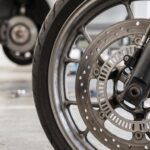
Single-channel ABS is available only on the SXC DD and TFT DD variants . Lower variants use synchronized braking (SBT) without ABS .
What this means: If you want ABS, you must buy the Raider’s top variants. The SP125 does not offer it at any price. For riders who prioritise safety—and in Indian traffic, that should be most riders—this is a significant distinction. ABS is not a luxury feature. It is a system that can prevent a fall in a panic-braking situation.
Editorial verdict: The Raider wins this section decisively. The SP125’s CBS is better than nothing, but ABS is the superior safety technology. Buyers who can stretch to the Raider’s SXC DD or TFT DD variants get a meaningfully safer bike.
5. Features and Equipment
The SP125’s 4.2-inch TFT with Bluetooth is a genuinely modern feature for a Honda commuter . The Raider’s 5-inch TFT is larger and includes navigation on the top variant . Both offer connectivity, but the Raider’s system is more feature-rich.
The Raider’s riding modes (Eco and Power) are useful for riders who want to prioritise efficiency or response. The SP125 has no equivalent, though its idling stop system serves a similar efficiency purpose.
The SP125’s kick-start is a practical advantage that is easy to overlook. If the battery dies, you can still start the bike. The Raider is self-start only .
6. Service and Ownership Costs
Drivio estimates that by 10,000 km, both bikes will require three or four service visits costing ₹4,000–5,000 in total, including oil changes . VaahanaInfo estimates a five-year service cost of ₹12,500 for both bikes .
The real difference is the dealer network. Drivio notes that “Honda’s wider dealer network is the real advantage, particularly outside metros” . For riders in smaller towns or rural areas, Honda’s service reach is a meaningful ownership advantage. TVS’s network is also extensive, but Honda’s is broader.
Resale value: Drivio states that “Honda’s resale strength is hard to beat” . If you plan to sell in four or five years, the SP125 will likely retain more of its value.
7. Which Bike Should You Buy?
The honest summary: The Raider offers better value if you prioritise features and safety (buy the ABS variant). The SP125 offers better value if you prioritise running costs and long-term ownership (fuel efficiency, resale, service reach).
8. Common Mistakes to Avoid
Mistake 1: Trusting the 71.94 kmpl figure. If you buy the Raider expecting 70+ kmpl, you will be disappointed. The more credible ARAI figure is 56.7 kmpl, and real-world efficiency is lower. Budget accordingly.
Mistake 2: Assuming the Raider has ABS across all variants. Only the SXC DD and TFT DD variants have ABS . Lower variants use synchronized braking.
Mistake 3: Assuming the SP125 has ABS. It does not. Honda equips it with CBS only . If ABS matters to you, the SP125 is not an option.
Mistake 4: Ignoring the tank size difference. The SP125’s 11-litre tank versus the Raider’s 10 litres, combined with better efficiency, means the Honda goes further between fills. For high-mileage commuters, this is a practical advantage.
Mistake 5: Overvaluing the EMI difference. Drivio’s analysis shows the Raider’s lower EMI saving is almost exactly offset by its higher fuel costs . The “cheaper” bike is not actually cheaper to own.
9. FAQs
Which is better, Honda SP125 or TVS Raider?
It depends on your priorities. The Raider offers more features, a sportier chassis, and ABS on top variants. The SP125 offers better fuel efficiency, longer range, wider service reach, and stronger resale value. For most commuters who value low running costs and long-term ownership, the SP125 is the safer bet. For riders who want features and safety, the Raider’s ABS variants are compelling.
What is the real mileage of TVS Raider 125?
The ARAI-claimed figure is 56.7 kmpl according to Autocar India and 2026 model listings . Some aggregator pages cite 71.94 kmpl, but this appears inconsistent with current specifications. Real-world efficiency is likely 50–54 kmpl .
Does Honda SP125 have ABS?
No. The SP125 uses Combined Braking System (CBS) only. ABS is not available on any variant .
Which bike has lower running costs?
The Honda SP125 likely has lower running costs due to better fuel efficiency (63 kmpl ARAI vs 56.7 kmpl) and a larger fuel tank. However, the difference is small—roughly ₹200 per month at 1,000 km/month .
What is the on-road price of Honda SP125 in Delhi?
The on-road Delhi price ranges from ₹97,195 to ₹1.05 lakh, depending on variant .
10. Final Verdict
The Honda SP125 vs TVS Raider comparison does not produce a single winner. It produces two valid answers for two different riders.
Buy the TVS Raider if: You want the most features for your money, you prioritise ABS (buy the SXC DD or TFT DD), or you want a 125cc commuter that feels less like an appliance. The Raider’s lower entry price and sportier character make it the more engaging choice.
Buy the Honda SP125 if: You ride 1,000+ km per month, you value fuel efficiency and range, you want the widest service network and strongest resale value, or you simply want a bike that will ask nothing of you beyond routine maintenance. The SP125 is the more rational long-term purchase.
The value verdict: If “value” means features per rupee, the Raider wins. If “value” means cost per kilometre over five years, the SP125 wins. Most Indian commuters should weight the second definition more heavily—but riders who want a bike they enjoy looking at and riding should not dismiss the Raider.
MOTORFOLIO — The Road to a Better Decision.