
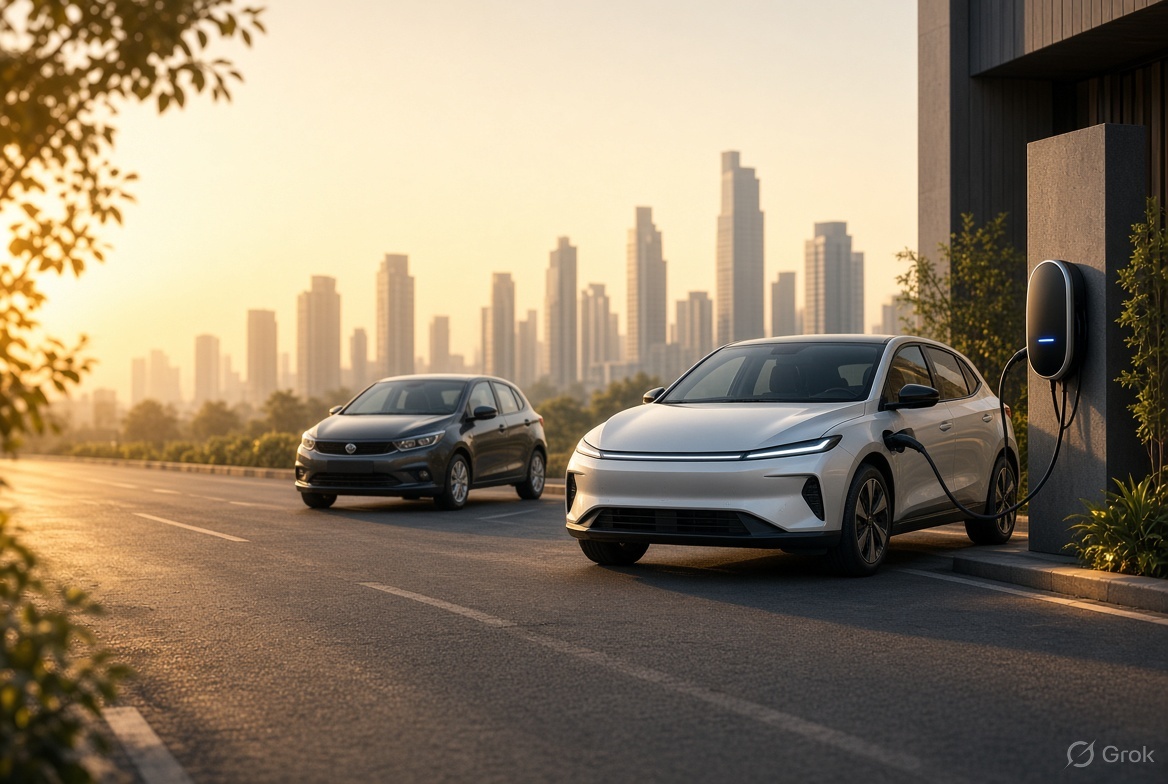
Electric vs Petrol Cars in India: Which Is Better for Your Budget?
MOTORFOLIO · Car Buying Guide · Updated 10 November 2026
Choosing between an electric car and a petrol car is no longer just about fuel economy. It is a decision about your purchase budget, daily driving distance, charging access, maintenance, road trips and how long you plan to keep the vehicle.
Electric vehicles (EVs) can substantially reduce energy costs when charged at home, while petrol cars offer familiar refuelling convenience and can be easier to live with if you regularly travel long distances without reliable charging access.
The short answer: An electric car may be the better financial choice for frequent commuters with convenient charging. A petrol car may offer better overall value if you drive relatively little, need unrestricted refuelling flexibility or want to minimise the initial purchase expense.
In this MOTORFOLIO guide, we compare the costs, practical advantages and limitations of both options for Indian buyers, with a transparent running-cost example and a checklist to help you decide.
Electric vs petrol cars: Quick comparison
| Factor | Electric car | Petrol car |
|---|---|---|
| Energy cost per kilometre | Often lower with affordable home charging | Depends on petrol price and actual mileage |
| Initial purchase price | Varies by model, battery and incentives | Often competitive in entry-level segments |
| Refuelling or charging | Home, workplace or public charging | Petrol stations |
| Long-distance travel | Requires range and charging-stop planning | Usually simpler to refuel en route |
| Routine servicing | Generally fewer powertrain service items | Engine oil, filters and other engine-related maintenance |
| Driving experience | Quiet, smooth acceleration | Familiar engine response and refuelling habits |
| Best use case | Predictable daily travel with charging access | Flexible use, occasional driving and varied routes |
| Main consideration | Charging access, upfront cost and battery warranty | Fuel expenses and routine engine maintenance |
Actual costs depend on the individual vehicle, driving conditions, electricity tariff, fuel prices and ownership period. Neither powertrain is automatically cheaper for every buyer.
1. What do electric cars cost in India?
Electric-car prices vary considerably by vehicle size, battery capacity, equipment and whether the advertised price includes a battery purchase or a battery-rental arrangement.
One example is the updated Tata Tiago EV. A May 2026 report listed its ex-showroom prices, excluding battery rental, as follows. These are published reference prices, not guaranteed offers available today. 【turn905369search0】
| Tata Tiago EV variant | Battery | Reported ex-showroom price |
|---|---|---|
| Smart | 19.2 kWh | ₹6.99 lakh |
| Pure+ | 19.2 kWh | ₹8.49 lakh |
| Pure+ | 24 kWh | ₹9.49 lakh |
| Creative+ | 24 kWh | ₹9.99 lakh |
Price verification: Recheck the current Tata.ev website and dealer quotation before publishing or purchasing. Battery-rental offers, where available, can change the initial price and ongoing ownership costs.
The Tiago EV’s published specifications include two battery options, a claimed range of approximately 226–285 km under the applicable test cycle, and support for AC and DC charging. Actual range varies with speed, traffic, air-conditioning, temperature and driving style. 【turn905369search1】
For buyers considering a larger electric SUV, Tata’s official Nexon.ev information lists a starting price of ₹12.49 lakh ex-showroom and a 30 kWh medium-range battery option. The manufacturer’s current variant page should be checked for the precise configuration and price. 【turn905369search3】
Important: Compare on-road prices, not just headline ex-showroom prices. Registration, insurance, accessories, charging equipment, state incentives and battery-rental terms can change the final cost.
2. What does a petrol car cost in India?
Petrol cars remain popular because they are available across a wide range of budgets, from entry-level hatchbacks to premium SUVs.
For a direct example, the 2026 Tata Tiago petrol was reported to start at ₹4.69 lakh ex-showroom, while the electric Tiago EV started at ₹6.99 lakh in its May 2026 facelift price list. The entry-level prices therefore differ by approximately ₹2.30 lakh. These are historical launch prices and must be rechecked before publication or purchase. (Autocar India — Tiago petrol, Autocar India — Tiago EV)
Petrol cars have several practical advantages:
- Petrol stations are widely available.
- Refuelling usually takes only a few minutes.
- You do not need to arrange home charging.
- A petrol model may have a lower entry price than its electric counterpart.
- Petrol can be convenient for irregular travel and long-distance journeys.
However, petrol expenses accumulate with every kilometre driven. If you commute daily or cover a large annual distance, fuel costs can become a substantial part of your ownership budget.
3. Electric vs petrol running cost: A real calculation
Let’s compare the energy cost of an electric car and a petrol car using a transparent example.
For this calculation, we’ll use Ahmedabad’s reported petrol price of ₹101.83 per litre on 10 November 2026. This is a city-specific reference price, not a nationwide rate. (NDTV Fuel Prices)
The electricity tariff and vehicle efficiency below are illustrative assumptions, not verified specifications for a particular vehicle. Replace them with your actual electricity bill rate and the real-world efficiency of your shortlisted cars.
Running-cost calculator
Change the assumptions to estimate monthly energy expenses for your own driving.Monthly distance (km)
1,000
100
1,500
3,000
Petrol car assumptions
Petrol price (₹/litre)
₹101.83
Real-world mileage (km/l)
15
Electric car assumptions
Electricity cost (₹/kWh)
₹8.00
Energy use (kWh/km)
0.15
Petrol · monthly
₹6,789
₹6.79/km
Electric · monthly
₹1,200
₹1.20/km
Estimated energy-cost difference per month
₹5,589 lower with EV
Energy only. Excludes purchase price, charging losses beyond the assumed consumption, maintenance, insurance, finance and resale value.
Reset example assumptions
Example result at 1,000 km per month
Using the initial assumptions:
Petrol car
- Petrol price: ₹101.83/litre
- Real-world mileage: 15 km/litre
- Fuel cost per kilometre: ₹101.83 ÷ 15 = ₹6.79
- Monthly fuel cost: approximately ₹6,789
Electric car
- Electricity tariff: ₹8/kWh
- Assumed energy use: 0.15 kWh/km
- Electricity cost per kilometre: ₹8 × 0.15 = ₹1.20
- Monthly electricity cost: ₹1,200
The estimated energy-cost difference is approximately ₹5,589 per month, or around ₹67,068 per year.
These figures are a worked example, not a guarantee of savings. Charging losses, public charging tariffs, traffic conditions and vehicle efficiency can change the result. The example also does not establish that an EV is cheaper overall, because it excludes the purchase-price difference and other ownership costs.
4. How long does it take to recover the extra EV purchase cost?
A lower running cost does not automatically mean a lower total cost of ownership. You must consider how much extra you pay upfront.
Using the historical Tata Tiago launch prices mentioned earlier:
| Item | Illustrative amount |
|---|---|
| Entry-level Tiago petrol ex-showroom price | ₹4,69,000 |
| Entry-level Tiago EV ex-showroom price | ₹6,99,000 |
| Difference in entry prices | ₹2,30,000 |
| Example annual energy-cost saving | ₹67,068 |
| Simple payback estimate | About 3.4 years |
The simple payback calculation is:
\[ \text{Payback period}= \frac{\text{Extra EV purchase cost}}{\text{Annual energy-cost savings}} \]
In this example:
\[ ₹2,30,000 \div ₹67,068 \approx 3.4\text{ years} \]
This is only a rough illustration, not a like-for-like buying recommendation. The quoted variants may differ in equipment, the current prices may have changed, and the on-road price difference can be different. It also excludes financing, maintenance differences, insurance, resale value and battery-related terms.
Before buying, compare the exact variants and use their current on-road quotations.
5. Maintenance: Which car costs less to maintain?
Electric cars have fewer routine powertrain service items because they do not require engine oil changes and do not have a conventional petrol engine, exhaust system or engine-related components such as spark plugs.
That can reduce some routine maintenance requirements, but it does not make EV maintenance free.
| Maintenance item | Electric car | Petrol car |
|---|---|---|
| Engine oil changes | Not required | Required according to schedule |
| Engine air filter and spark plugs | Not applicable | Applicable where fitted |
| Tyres | Require regular inspection and replacement | Require regular inspection and replacement |
| Brakes | Regenerative braking can reduce wear in some conditions | Conventional friction braking |
| Suspension and steering | Require routine checks | Require routine checks |
| Battery or engine system | High-voltage system and battery require appropriate servicing | Engine and fuel systems require servicing |
| Repairs outside warranty | Depends on fault and vehicle | Depends on fault and vehicle |
Maintenance costs depend on the manufacturer, service schedule, parts prices, driving conditions and warranty coverage. Ask the dealer for a scheduled-service estimate rather than assuming a universal percentage saving.
6. Charging access: The biggest practical difference
For many Indian buyers, charging convenience is more important than the advertised driving range.
Home charging
Home charging can make an EV especially convenient. You can often charge overnight and begin the next day with a higher state of charge.
Before purchasing, check:
- Whether you have a suitable private parking space.
- Whether a dedicated charging point can be installed safely.
- Whether your apartment society or landlord permits installation.
- The electrical connection, sanctioned load and installation costs.
- The applicable electricity tariff and any additional charges.
Do not assume a standard wall socket or the building’s electrical system is automatically suitable for every charging arrangement. Follow the vehicle manufacturer’s installation guidance and use a qualified electrician.
Public charging
Public charging can be useful when home charging is unavailable or during longer journeys. However, charger availability, charging speed, connector compatibility, pricing and reliability vary by location.
Before buying an EV, identify charging stations around your home, workplace and common travel routes. Check the charging network’s current app or website, not just a map pin.
Long-distance travel
A petrol car usually offers a straightforward refuelling experience on unfamiliar routes. An EV can also be suitable for road trips, but planning becomes more important.
Check the expected range at highway speeds, charging stops, charger availability and the time needed to recharge. A vehicle’s certified test-cycle range should not be treated as a guaranteed highway range.
7. Battery life, warranty and resale value
Battery condition is an important part of an electric car’s long-term ownership cost.
Before purchasing, check:
- The battery warranty duration and kilometre limit.
- Whether the warranty covers the complete battery pack or specifies capacity-related conditions.
- The warranty exclusions and required service conditions.
- The availability of authorised EV service centres nearby.
- The battery replacement or repair policy.
- The resale value of comparable used vehicles.
Do not assume every EV battery will need replacement after a fixed number of years. Battery degradation varies with chemistry, usage, climate, charging practices and vehicle design.
Resale value is also difficult to predict. It can depend on new-model pricing, battery warranty remaining, vehicle condition, technology changes, local demand and buyer confidence.
8. Which is better for your budget?
Tata Tiago.ev純電掀背房車發表,僅1萬美金起的售價再度震撼市場! – CARTURE 車勢文化
Choose an electric car if…
- You drive regularly and can charge at home or work.
- Your daily travel fits comfortably within the car’s practical range.
- You plan to keep the car for several years.
- Your expected energy savings justify the extra upfront cost.
- You have convenient access to service and charging infrastructure.
Tata Altroz Petrol DCA Real-world Mileage Tested – CarWale
Choose a petrol car if…
- You drive relatively few kilometres each month.
- You cannot reliably charge where you park.
- You frequently travel to places with limited public charging.
- You want to minimise your initial purchase expense.
- You prefer familiar refuelling and ownership routines.
What if you drive less than 500 km a month?
If your annual distance is low, the savings on energy may not recover an EV’s extra purchase cost quickly. A lower-priced petrol car may be financially sensible, provided it meets your needs.
What if you drive 1,500–2,000 km a month?
An EV becomes more worth evaluating because the potential energy-cost savings accumulate faster. However, charging convenience and the actual price difference still determine whether it is the better financial choice.
What if you live in an apartment?
Investigate charging access before booking the car. If you cannot charge reliably at home or work, public charging costs and travel to charging stations may reduce the convenience and financial benefits.
9. Common mistakes to avoid
- Comparing only the advertised range: Use realistic driving expectations.
- Ignoring the on-road price: Registration, insurance and equipment affect the purchase cost.
- Using one electricity rate for every situation: Home and public charging can have different tariffs.
- Assuming maintenance is free on an EV: Tyres, suspension, brakes and other components still require attention.
- Ignoring resale value: Future market prices can affect total ownership cost.
- Buying an EV without checking charging access: This can turn an economical choice into an inconvenient one.
- Assuming subsidies are guaranteed: Check current central and state eligibility, vehicle requirements and application rules before including incentives in your budget.
Frequently asked questions
Is an electric car cheaper than a petrol car in India?
It can be cheaper to run, particularly when charged at home. Whether it is cheaper overall depends on the purchase-price difference, annual distance, electricity and petrol prices, maintenance, financing and resale value.
Which is better for daily office commuting?
An EV can be a strong option if your daily distance fits its practical range and you can charge conveniently. A petrol car may be more suitable if your commute varies widely or you lack reliable charging access.
Is charging an electric car cheaper than buying petrol?
Often, yes, when home electricity is affordable and the vehicle is efficient. Public fast charging may cost more than home charging. Calculate the cost per kilometre using your local tariff and the vehicle’s real-world energy consumption.
Can an electric car be used for long road trips?
Yes, provided you plan around the vehicle’s usable range and the charging network on your route. Charging stops, charger reliability and highway energy consumption need to be considered.
Does an electric car require less maintenance?
EVs do not need engine oil changes and have fewer conventional engine-related service items. However, they still need inspections, tyre maintenance, brake checks and repairs when necessary.
How much does it cost to charge an EV at home?
A simple estimate is:
\[ \text{Charging cost}=\text{Electricity used in kWh}\times\text{Tariff per kWh} \]
For example, using 20 kWh at an assumed tariff of ₹8 per kWh costs ₹160 before any applicable additional charges or charging losses not included in the energy figure.
Are electric cars suitable for buyers on a tight budget?
Some electric hatchbacks have entry prices that overlap with conventional petrol models, but the final purchase cost and charging arrangement matter. Compare the exact variants and total cost of ownership rather than relying on a starting-price headline.
Should I buy an EV now or wait?
There is no universal answer. Buy now if an available model meets your needs, the finances work and charging is practical. Consider waiting if you need a different price range, better charging access or a specific vehicle that is not yet available.
Final verdict: Electric vs petrol cars in India
An electric car is worth serious consideration if you drive regularly, can charge conveniently and expect to keep the vehicle long enough to benefit from lower energy costs.
A petrol car remains a practical choice for buyers who prioritise a lower initial expense, flexible travel and easy refuelling.
The smartest decision is not based on fuel type alone. Compare the current on-road prices of equivalent vehicles, estimate your annual running cost, check service and charging access, and account for resale value before committing.
MOTORFOLIO recommendation: Calculate the total cost of ownership for your own driving pattern before booking. The cheapest car to run is not always the cheapest car to own.